Wednesday, May 26, 2010

Sumo Restaurant, Chanko, Ramen and Beast Looking Like a Fool in Japan


While researching for the trip - I read that there was a restaurant inside the sumo hall that served Chanko. Chanko, the sumo wrestler's stew, is the main dish sumo wrestlers eat every day. It is a very healthy dish except that it is eaten in massive quantities with rice and beer.

SBeast wasn't daring enough to try the dish - even though I told her I read it should have chicken in it (at the tournament they only serve chicken in their Chanko because they want to be on twos and not on fours like a cow or with no legs like a fish)... she tried a bowl of the ramen.

The Chanko showed up on a large tray - in a large bowl on top of a burner and surrounded by several smaller bowls filled with various vegetables, a single egg, rice, and bamboo filled with some type of mush.

The first scare I had came when I looked into the bowl and saw that the chicken was raw, but I shortly noticed that it appeared to be cooking within the stew.

Next, I turned my attention to the bowls of vegetables... smelling each of them first to determine if they seemed okay to add to the bowl. After adding some rice - Syl let me know that the Japanese woman behind me, who was also eating Chanko, had just put the contents of the bamboo inside of the stew so I did the same(I have no idea what it was and even though I added it to the stew I didn't dare try it)...

Then Syl exclaimed "Oh - she just put her egg in there too"... so I quickly grabbed my egg and tossed it into the stew... I learned very quickly that I shouldn't be so literal with what she was telling me when the waitress came running towards the table saying "no, no, no, no..." - I shoved my hand into the stew and grabbed the egg - tossing it back into the bowl it had come from.

The waitress in her best English tried to explain - she cracked the egg into the bowl and pointed at the bowl. I was too scared and feeling quite stupid at this point that I didn't dare try the egg again... After the waitress left the table, I asked Syl what I was supposed to do to the egg and she very unhelpfully suggested I dip something into it, but seeing that it was raw this was not something I was willing to try.

We had many laughs and beer as quietly as we could while Syl tried to not pee all over herself... when we got up to check out of the restaurant, the waitress pointed to her stomach and asked us if we were full... we told her we were and of course Syl had to tell her we were confused by the egg... the waitress pointed to the stew and said "inside" and "like dessert"... a very interesting experience... the stew had a great flavor...

As we exited the restaurant even more confused - we headed out of the sumo hall and towards Ryogoku station so we could head to our next destination.

Big Sumo and the Beasts First Japanese Photo Booth


We were very impressed with this big guy - he took hold of his opponents mawashi and tossed him out of the ring... he landed three rows back!

We watched a few hours of bouts before heading out to check out the sumo hall more...

We found our first Japanese photo booth and stepped inside to do our best sumo poses with some of the great Yokozuna of the past - very fun!

Sumo Shinto Tradition and Sumo Technique


Next we went inside of sumo hall to check out the Dohyo (sumo ring)...

Ring Traditions:

* the dohyo is covered in sand which is a symbol of purity in Shinto
* the yakata (canopy)above the ring is made to resemble the roof of a shrine
* the tassels on the yakata corners represent the seasons: white is autumn, black is winter, green is spring and red is summer
* the purple bunting on the roof symbolizes the clouds in the rotation of seasons
* the gyoji (referee) wears a robe like a Shinto priest
* salt is tossed before each bout for purification

Sumo Ritual Traditions:

* first the sumo clap their hands to awaken the g-ds
* then they raise their hands to show they are unarmed (dates to samurai days)
* next they stomp their feet to scare away any demons
* then they face each other and prepare to battle

We learned very quickly that pretty much anything goes when it comes to technique... the only things not allowed is the pulling of hair, closed fist hits (their is a lot of slapping going on though), boxing of the ears, choking the throat (pushing the throat is allowed), or grabbing each others mawashi in the crotch.

The thing they wear is called a mawashi - it has decorative braids that can detach during the bout that represent the ropes at Shinto shrines (Yokozuna - grand champions get to wear decorative zigzags on their mawashi that resemble the fronts of shrines - higher ranking rikishi are also the only ones allowed to wear colorful mawashi)...

It appeared that the best technique and advantage came when one could get hold of the others mawashi and force them out of the ring or onto the ground...

Sumo Shrine, the Big Prize, and Beast Sneaking Pic With Sumo


Sumo began as a ritual of Shinto (Japanese religion) and dates back over 2000 years. Originally sumo was used as a way to entertain and please the g-ds with the hope that the g-ds would bring healthy harvest in return.

The traditions of sumo all point to purification rituals of Shintoism.

We found two small Shinto shrines within the inner gates of the sumo hall - like many shrines they were guarded by a pair of kitsune. Kitsune or foxes are considered to be protective beings with supernatural abilities such as possession, invisibility, manifestation in dreams, illusions, and driving people mad. Kitsune are protective, but will use their supernatural abilities to trick those who are overly proud, greedy or boastful.

After checking out the shrines, we headed inside to the lobby where we found the ranking and awards display... included was the big prize handed out at the end of each tournament: the Emperor's Cup.

Next we checked out the sumo wall art inside of the lobby and the museum... the Beast also snuck in a photo with a sumo wrestler.

Ryogoku Kokugikan


The current Ryogoku Kokugikan or Sumo Hall opened in 1985 and hosts three of the six bashos each year. The original Kokugikan was built in 1909 and was used until 1945 when WWII shut it down... tournaments were held at the Meiji Shrine until 1954.

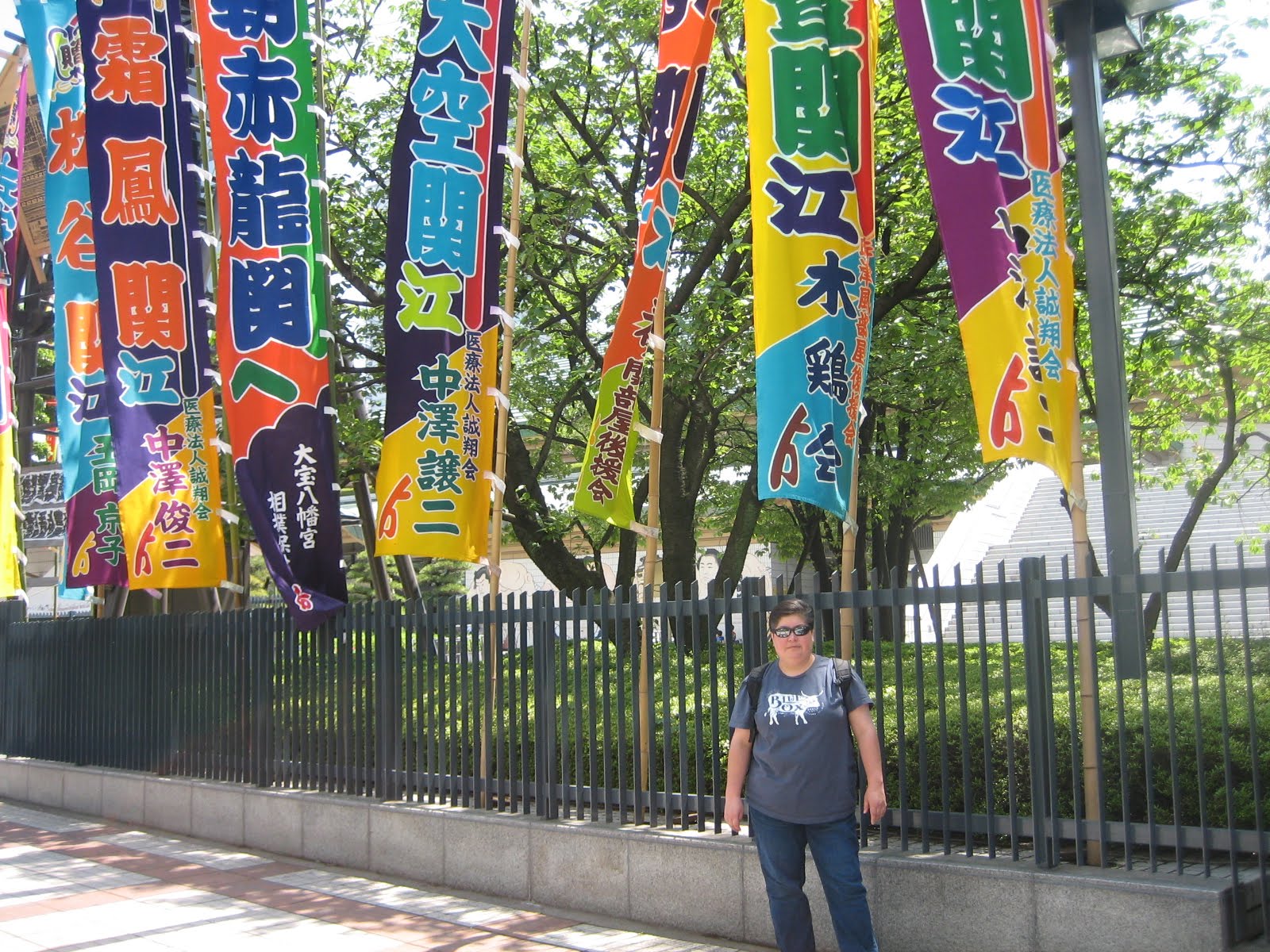
The front of the Kokugikan has really colorful banners with the sumo wrestlers names on them, a great sumo wall mural, and an area where sumo-goers can pose with the official characters of sumo.

After entering through the ticket entrance (stationed by retired sumo wrestlers - we did our sumo posing.

Straight and Straight and Go ---->


We stumbled out into the street in front of the cafe and headed straight ahead down a long winding walkway filled with unlocked bikes (yet another sign of the low crime rate)...

Soaking in the sun - we passed several Yakitori-ya, sushi houses, 100 yen store (dollar store), and another McDonalds until we reached the first possible street we could turn right at...

We weren't sure if we were near our location until we spied a few sumo heading in for their morning practice before their afternoon bouts.

Tokyo Day 5: Heading to Sumida-ku


Woke up early Friday morning (5/21), prepared my metro travel routes for our busy day, and headed towards the Sumida ward of Tokyo. First destination - Ryogoku station to watch the May Sumo Basho (tournament).

We seem to have finally mastered Tokyo's metro system, or at least we reached our destination with out any major confusions. (We were met at one station stop by two very nice Japanese men pointing off - not really sure what happened here, but when we looked around we were the only ones on... so we quickly jumped off and got on the next one that arrived.)

After arriving at Ryogoku station - we headed above ground in search of the sumo stadium. We walked up one street while looking around, but couldn't see the stadium so we went inside of a little cafe called "Saint EToile" to get something quick to snack on and try to ask for directions. We found an interesting sandwich that was labeled as a "Sandwich Burger". It appeared to be a breaded chicken sandwich, but I'm pretty positive it wasn't chicken and we never could figure out what type of meat it was. Even though we had no idea what it was - it actually tasted really good. We also shared a small slice of raisin bread.

Completing our interesting morning snack, we got directions from two very nice women who didn't understand our Japanese and couldn't really speak English. They pointed and said something like "straight and straight and go" then pointed to their right and giggled.